Showing posts with label Beginner. Show all posts

Saturday, May 23, 2015

Openings for Beginners


What opening should I play?

I see this question a lot on internet forums.  There are so many openings, with multiple paths and transpositions, it is no wonder beginners are confused.

General Advice

The advice most often given to beginners is to play the open games.  These are the openings that start with White playing 1.e4 and Black responding with 1...e5.  These openings are called the open games because there are usually pawns traded on the center squares resulting in open central files and diagonals.  With all these open lines, the pieces come into play quickly and it is often easy to figure out the best squares for your pieces.  Quick development, king safety, and the fight for the central squares are usually the main priorities of the open games.

All of the above tends to make the open games good for learning, but I think the best reason to play the open games is that when you lose, it will usually be easy to figure out your mistake because it will be punished tactically right away.  In the closed games, your positional mistake may not be exploited for another 10 moves, and the beginner will not be able to make the logical connection.

Who is the target audience of this advice?

The title says openings for beginners, and certainly anybody just learning to play chess should consider the opening advice listed below.  I would think players rated under 1200 should also be trying out these openings.  All the lines I give have been played by masters, so there is no need to worry that these lines are unsound.  If they suit your style you could play them as you progress up through ratings of 1600 to 1800.

I should also note that these recommendations are intended to maximize learning, not increase short term performance.  You may lose a higher percentage of games at first if you adopt these openings, but I am confident that your understanding will improve, and in the long term, so will your results.

Now for some specifics

To cut to the chase, I am recommending the Scotch Game, but using a modified move order.

The Scotch Game is usually reached by:

1. e4  e5
2. Nf3  Nc6
3. d4

when Black almost always plays  3...exd4


The move order I recommend is:

1. e4  e5
2. d4  dxe4
3. Nf3

and if Black responds with 3...Nc6, then we will have reached the same position.


Why this move order?

There are a couple of reasons why I recommend this particular move order.

  • Some of Black's best options are avoided with this move order (see notes below)
  • There are more opportunities for Black to make a mistake
Of course nothing comes for free, and Black will have a few options against this move order that are not available otherwise, but these are of little consequence.


What if Black doesn't play those moves?

That is a very good question.  I first want to show some lines in the Scotch Game, then I will give some advice on how to play if Black plays moves other than those that lead to the Scotch Game.

The Scotch Game

We will consider two main variations in the Scotch Game following these moves:

1. e4  e5
2. d4  exd4
3. Nf3  Nc6
4. Nxd4

Black will usually play either 4...Bc5 or 4...Nf6.   You will also need to prepare for 4...Qh4.   Beginners will sometimes play 4...Nxd4, but this should cause you no trouble.


Gambit options for White

White can choose not to re-capture the pawn on move 4.  There are some options where White can sacrifice a pawn to gain a lead in development with lots of open lines that may lead to an early attack.
4.Bc4 is the Scotch Gambit
4.c3 is the Goring Gambit.


When Black does not play 3...Nc6

These are some moves that Black may play instead of 3...Nc6
3...Nf6 is a variation of the Petroff Defense
3...d6 is a line in the Philidor Defense
3...Bb4+ and 3...Bc5 are options that are unique to this move order, but not problems for White.
3...c5 is sometimes played by beginners and is just bad for Black.


What if Black does not play 1...e5?

That will have to be another chapter.  In most cases, the idea of playing 2.d4 will be the right move, and against the Sicilian, you can follow up with 3.Nf3.


Summary

As White, I recommend beginning players aim for the Scotch Game (or possibly the Scotch Gambit) using the 2.d4 move order.   This will lead to positions that beginning players will be able to understand and learn from.  This last diagram is a summary of the lines discussed above.


Sunday, February 8, 2015

Opening Names - Tree Diagrams


What is the deal with opening names?

There are sequences of opening moves that are played over and over again.  This is because the moves make sense in accomplishing the goals of the opening.  These goals are:
  • Develop the pieces off the back rank and into the game
  • Fight for the center of the board
  • Castle your king into safety

The names of openings have been assigned pretty much by accident over history.  Openings can be named after:
  • The first player who popularized the opening
  • The city or country where the opening was first popular
  • A descriptive name of the what is happening on the board

Do I need to learn all of the opening names?

No, you don't need to learn the names of all of the openings, but you should probably learn the names of the openings you play.  The best way to do this is to write down the moves of your next game (if you are playing online, most servers will record the moves for you).  After the game, look up the moves on the tree diagrams below and try to find the name of the opening you just played.  If the moves you played do not have a name, you may have been playing inferior moves and should consider one of the moves from the diagram instead.

Once you know the name of the opening you play, you can search on the internet for more information about that opening.  There are even videos that explain the finer points of each opening.


And now, the tree diagrams

I couldn't fit all of the openings on one diagram, so I broke them up according to the common classification system, which is explained in the first diagram.  Note:  There are many other openings that I did not include here.  These are either very rarely played anymore, or are not suited for improving players.


Next Steps

Now that you know the name of the openings you like to play, you can make your own tree diagrams showing the variations and sub-variations of those openings.  There are plenty of internet resources to guide you.  Old school players like me still read about the variations in books.

You should also plan to spend some time learning about the openings your opponents might use to prevent you from playing your opening,  For example, suppose you like to play the Scotch opening as White.   From the diagrams, you will notice that Black does not have to follow the path that leads to the Scotch.  After 1.e4 e5,  2.Nf3 Black does not have to play 2...Nc6.   Black can choose to play 2...Nf6 (Petroff Defense) or 2...d6 (Philidor Defense) instead.  Also, Black does not have to reply with 1...e5, but could choose any of the Semi-Open defenses instead.

I enjoy learning about the openings and I hope this information will help you get started improving your opening play.


Monday, January 19, 2015

How to Lose at Chess - Checkmate Patterns


Checkmate Patterns


Pattern recognition is an important skill for losing at chess.  The following examples show checkmate patterns that you can try to emulate in your games.  Let us hope your opponent knows these patterns too.

Back Rank Mate

The most common mating pattern occurs when one player leaves the back rank unprotected, and the king has no escape square.

In the diagram below:  White to move wins with 1.Qa8#

If you have the white pieces a good way to lose is to make a useless move with your queen, such as 1...Qa7.   Then Black wins using the back rank mate pattern with 2...Rd1#.


Damiano's Mate

This partial diagram shows the final position of Damiano's mate. 


If Black could reach the next position, White could force checkmate in 5 moves.  (Hint:  Eliminate the rooks with check to get the queen on the h-file.)


If you have the white pieces, you can lose by making a useless move such as 1.Rh2 allowing Black to mate you using Damiano's mate.


Anastasia's Mate

This partial diagram shows the final position of Anastasia's mate.


The following position comes from the novel Anastasia and Chess by W. Heinse in 1803.  From this position, White would be able to force mate in 3 moves.


Boden's Mate

This partial diagram shows the final position of Boden's mate.


If Black could reach the following position, White could force mate in 2 moves.


You should try to create positions like this where your opponent can sacrifice a piece to expose your king.


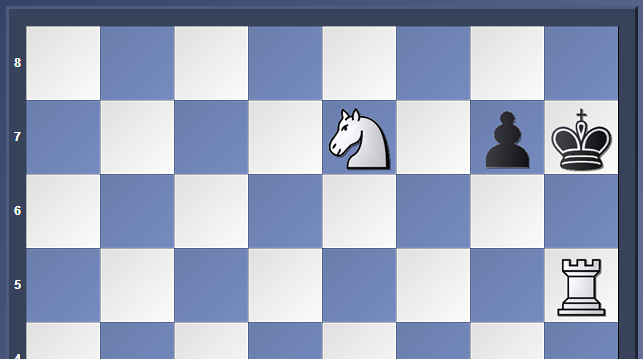
Smother Mate

This partial diagram shows the final position of a smother mate.


If Black could reach the following position, White could force mate in 5 moves.


I will leave it as an exercise for the reader to find a move for White that would allow a back rank checkmate.


How to Lose at Chess - Introduction

How to Lose at Chess - Losing by Checkmate

Sunday, January 18, 2015

How to Lose at Chess - Checkmate in the Opening


Checkmate in the Opening

In the opening, you can increase your chances of being checkmated by failing to develop your pieces off the back rank and by making lots of pawn moves that expose the king. Also, you should never castle if that would make your king safer.


Fool's Mate

It is possible to be checkmated in just a few moves. The following example is often called the “Fool's Mate”.


Notice that by moving his pawns on the f and g files, White has done an excellent job of exposing his king to check along the diagonal that runs from e1 to h4. When you want to lose quickly, move the pawns protecting your king.


Scholar's Mate


The f7 square is a particularly weak square right next to Black's king. If you are lucky, White may try to checkmate you quickly on f7.


Black could have defended f7 by playing 3...Qe7 or blocked the queen check with 3...g6. Surely you would not play either of those moves.

Be sure to keep the square f7 unprotected if you want to be checkmated early in the game.


Legal's Mate


Many players of the White pieces will not bring their queen out early to attempt the Scholar's mate. A more sophisticated way to get checkmated is Legal's mate.

Black's move 4...g6 was a clever losing strategy. Developing a piece by 4...Nc6 or 4...Be7 would have avoided the mate.

Moving pawns instead of developing pieces in the opening is a good way to get checkmated early.


Blackburne Shilling Mate


The story says the master Blackburne would play amateurs for a shilling a game. He would often play these moves as Black and usually win quickly.


White did not have to take the pawn with 4.Nxe5. Greedily grabbing pawns instead of developing pieces is an excellent technique for losing quickly.


Notice how in all of these examples, the losing side did not develop the back rank pieces and castle. It is usually harder to get checkmated if you castle early.


How to Lose at Chess - Introduction

How to Lose at Chess - Losing by Checkmate


How to Lose at Chess - Losing by Checkmate


Losing by Checkmate


As beginners, we all learn that you lose a game by getting checkmated. Later, if you start playing tournament chess, you learn that you can simply resign a game, or lose on time. Unfortunately, you may find yourself in a casual game with no clock, and an opponent who will not accept your resignation. For situations like this, you will need to learn how to get checkmated.


There are three keys to getting checkmated:

  1. Expose your king to attack along open lines.
  2. Leave the squares around your king unprotected.
  3. Limit the number of squares your king can move to.

In future posts we will use these ideas as we learn about getting checkmated in the opening phase of the game, typical mating patterns, and as a last resort, checkmates in the endgame.

How to Lose at Chess - Introduction


How to Lose at Chess - Introduction


I can only imagine why anyone would want to lose a game of chess. Perhaps you are forced into a situation where you must play a game against a person of superior position at work and you dare not win for fear of reprisal. Or perhaps you will be playing against a relative on their deathbed and do not want your loved one's last game to be a defeat.


Whatever the reason you want to lose at chess, I will provide you with all the tools needed to succeed at your task. You will learn how to get checkmated, how to lose your pieces, and how to make your position so bad that you cannot avoid loss. Many of these techniques will allow you to disguise your objective of losing.

 
Some have suggested that people may try to use this information for the exact opposite reason; to try to avoid these mistakes and improve their game. I find this idea preposterous and will give it no further consideration.

Topics of future posts to this blog:
  • Losing by Checkmate (Checkmate in the opening, typical mating patterns, checkmate in the endgame)
  • Losing material (Value of the pieces, blunders, counting, forks, discovered attacks, pins skewers, removing the guard, combinations)
  • Positional Mistakes (Weak pawns, weak squares, good and bad pieces)
  • Example games

I wish you the best (or perhaps that should be worst) of luck in your future chess endeavors.