Showing posts with label How to Lose at Chess. Show all posts

Monday, January 19, 2015

How to Lose at Chess - Checkmate Patterns


Checkmate Patterns


Pattern recognition is an important skill for losing at chess.  The following examples show checkmate patterns that you can try to emulate in your games.  Let us hope your opponent knows these patterns too.

Back Rank Mate

The most common mating pattern occurs when one player leaves the back rank unprotected, and the king has no escape square.

In the diagram below:  White to move wins with 1.Qa8#

If you have the white pieces a good way to lose is to make a useless move with your queen, such as 1...Qa7.   Then Black wins using the back rank mate pattern with 2...Rd1#.


Damiano's Mate

This partial diagram shows the final position of Damiano's mate. 


If Black could reach the next position, White could force checkmate in 5 moves.  (Hint:  Eliminate the rooks with check to get the queen on the h-file.)


If you have the white pieces, you can lose by making a useless move such as 1.Rh2 allowing Black to mate you using Damiano's mate.


Anastasia's Mate

This partial diagram shows the final position of Anastasia's mate.
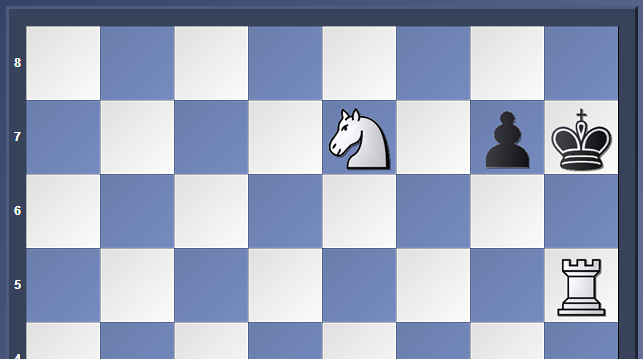


The following position comes from the novel Anastasia and Chess by W. Heinse in 1803.  From this position, White would be able to force mate in 3 moves.


Boden's Mate

This partial diagram shows the final position of Boden's mate.


If Black could reach the following position, White could force mate in 2 moves.


You should try to create positions like this where your opponent can sacrifice a piece to expose your king.


Smother Mate

This partial diagram shows the final position of a smother mate.


If Black could reach the following position, White could force mate in 5 moves.


I will leave it as an exercise for the reader to find a move for White that would allow a back rank checkmate.


How to Lose at Chess - Introduction

How to Lose at Chess - Losing by Checkmate

Sunday, January 18, 2015

How to Lose at Chess - Checkmate in the Opening


Checkmate in the Opening

In the opening, you can increase your chances of being checkmated by failing to develop your pieces off the back rank and by making lots of pawn moves that expose the king. Also, you should never castle if that would make your king safer.


Fool's Mate

It is possible to be checkmated in just a few moves. The following example is often called the “Fool's Mate”.


Notice that by moving his pawns on the f and g files, White has done an excellent job of exposing his king to check along the diagonal that runs from e1 to h4. When you want to lose quickly, move the pawns protecting your king.


Scholar's Mate


The f7 square is a particularly weak square right next to Black's king. If you are lucky, White may try to checkmate you quickly on f7.


Black could have defended f7 by playing 3...Qe7 or blocked the queen check with 3...g6. Surely you would not play either of those moves.

Be sure to keep the square f7 unprotected if you want to be checkmated early in the game.


Legal's Mate


Many players of the White pieces will not bring their queen out early to attempt the Scholar's mate. A more sophisticated way to get checkmated is Legal's mate.

Black's move 4...g6 was a clever losing strategy. Developing a piece by 4...Nc6 or 4...Be7 would have avoided the mate.

Moving pawns instead of developing pieces in the opening is a good way to get checkmated early.


Blackburne Shilling Mate


The story says the master Blackburne would play amateurs for a shilling a game. He would often play these moves as Black and usually win quickly.


White did not have to take the pawn with 4.Nxe5. Greedily grabbing pawns instead of developing pieces is an excellent technique for losing quickly.


Notice how in all of these examples, the losing side did not develop the back rank pieces and castle. It is usually harder to get checkmated if you castle early.


How to Lose at Chess - Introduction

How to Lose at Chess - Losing by Checkmate


How to Lose at Chess - Losing by Checkmate


Losing by Checkmate


As beginners, we all learn that you lose a game by getting checkmated. Later, if you start playing tournament chess, you learn that you can simply resign a game, or lose on time. Unfortunately, you may find yourself in a casual game with no clock, and an opponent who will not accept your resignation. For situations like this, you will need to learn how to get checkmated.


There are three keys to getting checkmated:

  1. Expose your king to attack along open lines.
  2. Leave the squares around your king unprotected.
  3. Limit the number of squares your king can move to.

In future posts we will use these ideas as we learn about getting checkmated in the opening phase of the game, typical mating patterns, and as a last resort, checkmates in the endgame.

How to Lose at Chess - Introduction


How to Lose at Chess - Introduction


I can only imagine why anyone would want to lose a game of chess. Perhaps you are forced into a situation where you must play a game against a person of superior position at work and you dare not win for fear of reprisal. Or perhaps you will be playing against a relative on their deathbed and do not want your loved one's last game to be a defeat.


Whatever the reason you want to lose at chess, I will provide you with all the tools needed to succeed at your task. You will learn how to get checkmated, how to lose your pieces, and how to make your position so bad that you cannot avoid loss. Many of these techniques will allow you to disguise your objective of losing.

 
Some have suggested that people may try to use this information for the exact opposite reason; to try to avoid these mistakes and improve their game. I find this idea preposterous and will give it no further consideration.

Topics of future posts to this blog:
  • Losing by Checkmate (Checkmate in the opening, typical mating patterns, checkmate in the endgame)
  • Losing material (Value of the pieces, blunders, counting, forks, discovered attacks, pins skewers, removing the guard, combinations)
  • Positional Mistakes (Weak pawns, weak squares, good and bad pieces)
  • Example games

I wish you the best (or perhaps that should be worst) of luck in your future chess endeavors.