Sunday, February 15, 2015

Data Visualizations by Randy Olson


I just ran across Randy Olson's blog where he does data visualizations.   Info about Randy Olson from his blog:


Randy is a PhD candidate in Michigan State University's Computer Science program. As a member of Dr. Chris Adami's research lab, he studies biologically-inspired artificial intelligence and evolutionary processes.


He published a series of 4 blog articles with data visualizations of chess topics.


  1. Chess tournament games and Elo ratings 
  2. A data-driven exploration of the evolution of chess: Game lengths and outcomes
  3. A data-driven exploration of the evolution of chess: Popularity of openings over time
  4. A data-driven exploration of the evolution of chess: Moves, captures, and checkmates

Sunday, February 8, 2015

Opening Names - Tree Diagrams


What is the deal with opening names?

There are sequences of opening moves that are played over and over again.  This is because the moves make sense in accomplishing the goals of the opening.  These goals are:
  • Develop the pieces off the back rank and into the game
  • Fight for the center of the board
  • Castle your king into safety

The names of openings have been assigned pretty much by accident over history.  Openings can be named after:
  • The first player who popularized the opening
  • The city or country where the opening was first popular
  • A descriptive name of the what is happening on the board

Do I need to learn all of the opening names?

No, you don't need to learn the names of all of the openings, but you should probably learn the names of the openings you play.  The best way to do this is to write down the moves of your next game (if you are playing online, most servers will record the moves for you).  After the game, look up the moves on the tree diagrams below and try to find the name of the opening you just played.  If the moves you played do not have a name, you may have been playing inferior moves and should consider one of the moves from the diagram instead.

Once you know the name of the opening you play, you can search on the internet for more information about that opening.  There are even videos that explain the finer points of each opening.


And now, the tree diagrams

I couldn't fit all of the openings on one diagram, so I broke them up according to the common classification system, which is explained in the first diagram.  Note:  There are many other openings that I did not include here.  These are either very rarely played anymore, or are not suited for improving players.


Next Steps

Now that you know the name of the openings you like to play, you can make your own tree diagrams showing the variations and sub-variations of those openings.  There are plenty of internet resources to guide you.  Old school players like me still read about the variations in books.

You should also plan to spend some time learning about the openings your opponents might use to prevent you from playing your opening,  For example, suppose you like to play the Scotch opening as White.   From the diagrams, you will notice that Black does not have to follow the path that leads to the Scotch.  After 1.e4 e5,  2.Nf3 Black does not have to play 2...Nc6.   Black can choose to play 2...Nf6 (Petroff Defense) or 2...d6 (Philidor Defense) instead.  Also, Black does not have to reply with 1...e5, but could choose any of the Semi-Open defenses instead.

I enjoy learning about the openings and I hope this information will help you get started improving your opening play.


Monday, January 26, 2015

A Recent Correspondence Game


This is a correspondence game I recently played on Chessworld.net.

The final position is very similar to the Damiano's mate I give in an earlier post.

Saturday, January 24, 2015

Thoughts on Opening Repertiore Choices


Why have a specific opening repertoire?
  • To specialize in a limited set of openings
  • To minimize the amount of study required
Why have I chosen to have to have 2 sets of opening choices?
  • Because my objectives differ when playing higher or lower rated opponents
  • To get exposure to a larger set of opening ideas and positions
  • To avoid boredom and stagnation
  • To have a back-up plan in case my opponent is prepared for my opening
Objectives against higher rated players.
  • To paraphrase Simon Webb -  The tiger must lead the elephant into the swamp.
  • Maximize my tactical chances
  • Unclear / dynamic positions
  • Drawish lines OK – especially forcing tactical lines
  • All pawn structures, including IQP
  • Stay in book.  I want them to leave book worried about my prepared lines.
Objectives against lower rated players.
  • The tiger waits for the rabbit to make a mistake
  • Minimize my opponent's tactical chances
  • Strategically sound positions
  • Avoid drawish lines
  • Avoid symmetrical pawn structures
  • Avoid pawn weaknesses
  • Get them out of their prepared lines.

Thursday, January 22, 2015

Chess Graphs: Risk vs. Reward


How to play against lower rated players

I have been given conflicting advice on how to play lower rated players.  On the one hand, a strong master told me I should play the sharpest tactical opening lines, and try to blow my lower rated opponent out of the water as quickly as possible.

On the other hand, I get this advice from the book Chess for Tigers by Simon Webb.

"Do you know how Tigers catch Rabbits?  Do they rush after them and tear them limb from limb?  Or do the stalk them through the bush before finally creeping up on them when their resistance is low?"

My personal experience has lead me to believe the  2nd approach makes more sense.  When I play complicated forcing moves against my lower rated opponents, I often just put them in a position where they must find the one move that doesn't lose, and they sit there until they find it.  In effect, I am forcing them to play good moves.  When I play less forcing moves (still strong moves, just less forcing) I sometimes give my lower rated opponents more chances to make positional errors that I can exploit later.


Now for the Graphs

Imagine if I were to make a scatter plot of chess games.  On the x axis would be a measure of the risk involved in the chosen moves (I'm not sure how I would measure this, but sacrifices and gambits would be on the high end of the scale).  On the y axis would be a measure of the outcome of the games, from loss to win, perhaps measured by computer evaluations of the final positions.

That graph might look something like this:


For two equally rated players, I would expect all of the data points to fall between the two dashed lines.  Notice that when neither player takes much risk, a draw is a likely result.  As either player increases the risk, however, the chance of a win or loss increases.

Now consider games where one player is much higher rated than the other.  By much higher rated, I mean at least 200 rating points higher (you would expect the higher rated player to score 75% ).  I expect the shape of the points to be about the same, just shifted higher.


Looking at this graph, I would conclude that the higher rated player has almost no chance of losing the game if the risk level stays low.  As the risk level increases, the chances of winning increase slightly, but so do the chances of losing. 

There is a phrase used by strong players when referring to a situation where one player is controlling the risk level of the game in order to avoid a loss.  They say the player is "playing for 2 results."  Those results being a win or a draw.  If there is some risky play (a sacrifice perhaps), the player is "playing for all 3 results."


How to play against higher rated players

So if the higher rated player wants to minimize the risk involved, the opposite must be true for the lower rated player.  Looking at the graph, it appears the only chance the lower rated player has is to maximize the risk level.

Once again, I quote Simon Webb:

"The basic principle is to head for a complicated or unclear position such that neither of you has much idea what to do, and hope that he makes a serious mistake before you do.  Of course you are still more likely to lose than to win, but by increasing the randomness of the result you are giving yourself more chance of a 'lucky' win or draw."

 He then gives some pointers for increasing the risk level against higher rated players.  (I am paraphrasing):
  1. Choice of Opening -  Sharp theoretical lines and gambits.
  2. Play actively-  Aggressive attacking play, even if that means sacrificing a pawn or two.
  3. Randomize - Create unclear and unbalanced positions; complications that can't be figured out over the board.
  4. Don't swap everything off -  Strong players are better in the endgame, so keep the pieces on the board and stay in the middle game.
  5.  Be brave - Your opponent is higher rated so you have nothing to lose.

Conclusion

My tournament experience has convinced me that this is the correct advice.  Against a lower rated player, I accumulate small advantages and trade down to a winning endgame.   My games may last a long time, but I win a very high percentage of them.  Against higher rated players, I throw everything I have at them, often in a caveman like style, but I have some nice upsets as a result.

In a future post, I will show how I changed my opening repertoire to take this advice into account.


Monday, January 19, 2015

Types of chess "rules"


As I am reading about chess, I come across many types of advice and information that are called "rules". Here I have classified them into 5 groups. I would like to hear your opinion about this classification and some examples of "rules" that do or do not fit into this classification.

1. Rules of the game. What FIDE calls the Laws of Chess. These are the rules that govern how the pieces move and capture, how castling is performed, pawn promotion, etc. These rules are the same for OTB, correspondence or blitz chess.

2. Tournament rules. These would be rules that govern how pairings are done, the use of the clock, notation requirements, claiming draws, etc. These rules differ according to the type of competition. Correspondence rules differ from OTB and blitz.

3. Rules of strategy. What I am thinking here would be the fundamental rules that guide decisions of strategy. This would include the relative value of the pieces, the advantage of two bishops in an open position, rooks behind passed pawns in the endgame. Rules in this category would be expected to have few exceptions. If they had zero exceptions, and could be assumed to be true without further proof, we would call them axioms. Can anybody give an example of an axiom of chess strategy?

4. Rules of thumb. These would be rules that have so many exceptions that they must be considered only as rough guidelines. Knights before bishops is a good example. Some in this category might be called parables: for example the story of the man who left his inheritance on the condition that his son never captured a b-pawn with his queen.

5. Rules about how to think. Not specifically about strategy, but more about how to manage your own thought processes. Kotov's tree of analysis for example. Or the advice: If you see a good move, look for a better one.

Have I missed any categories of rules? Do you have examples that do not fit into these categories? What are your favorite rules?

How to Lose at Chess - Checkmate Patterns


Checkmate Patterns


Pattern recognition is an important skill for losing at chess.  The following examples show checkmate patterns that you can try to emulate in your games.  Let us hope your opponent knows these patterns too.

Back Rank Mate

The most common mating pattern occurs when one player leaves the back rank unprotected, and the king has no escape square.

In the diagram below:  White to move wins with 1.Qa8#

If you have the white pieces a good way to lose is to make a useless move with your queen, such as 1...Qa7.   Then Black wins using the back rank mate pattern with 2...Rd1#.


Damiano's Mate

This partial diagram shows the final position of Damiano's mate. 


If Black could reach the next position, White could force checkmate in 5 moves.  (Hint:  Eliminate the rooks with check to get the queen on the h-file.)


If you have the white pieces, you can lose by making a useless move such as 1.Rh2 allowing Black to mate you using Damiano's mate.


Anastasia's Mate

This partial diagram shows the final position of Anastasia's mate.


The following position comes from the novel Anastasia and Chess by W. Heinse in 1803.  From this position, White would be able to force mate in 3 moves.


Boden's Mate

This partial diagram shows the final position of Boden's mate.


If Black could reach the following position, White could force mate in 2 moves.


You should try to create positions like this where your opponent can sacrifice a piece to expose your king.


Smother Mate

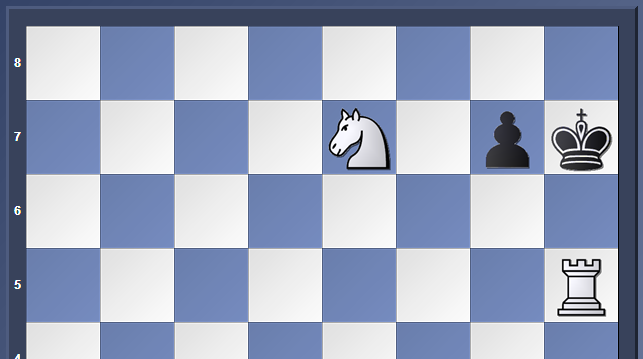
This partial diagram shows the final position of a smother mate.


If Black could reach the following position, White could force mate in 5 moves.


I will leave it as an exercise for the reader to find a move for White that would allow a back rank checkmate.


How to Lose at Chess - Introduction

How to Lose at Chess - Losing by Checkmate